
CEIP vs. Solar Loans: Which Financing Option Is Right for You?

If you're financing solar in Alberta in 2026, you basically have two real options: CEIP (Clean Energy Improvement Program) or a traditional solar loan from a bank, credit union, or specialty lender. Both work. Neither is universally better. The right one depends on your situation — and we'll tell you when each makes sense, including when we'd recommend a loan over CEIP.
The quick comparison
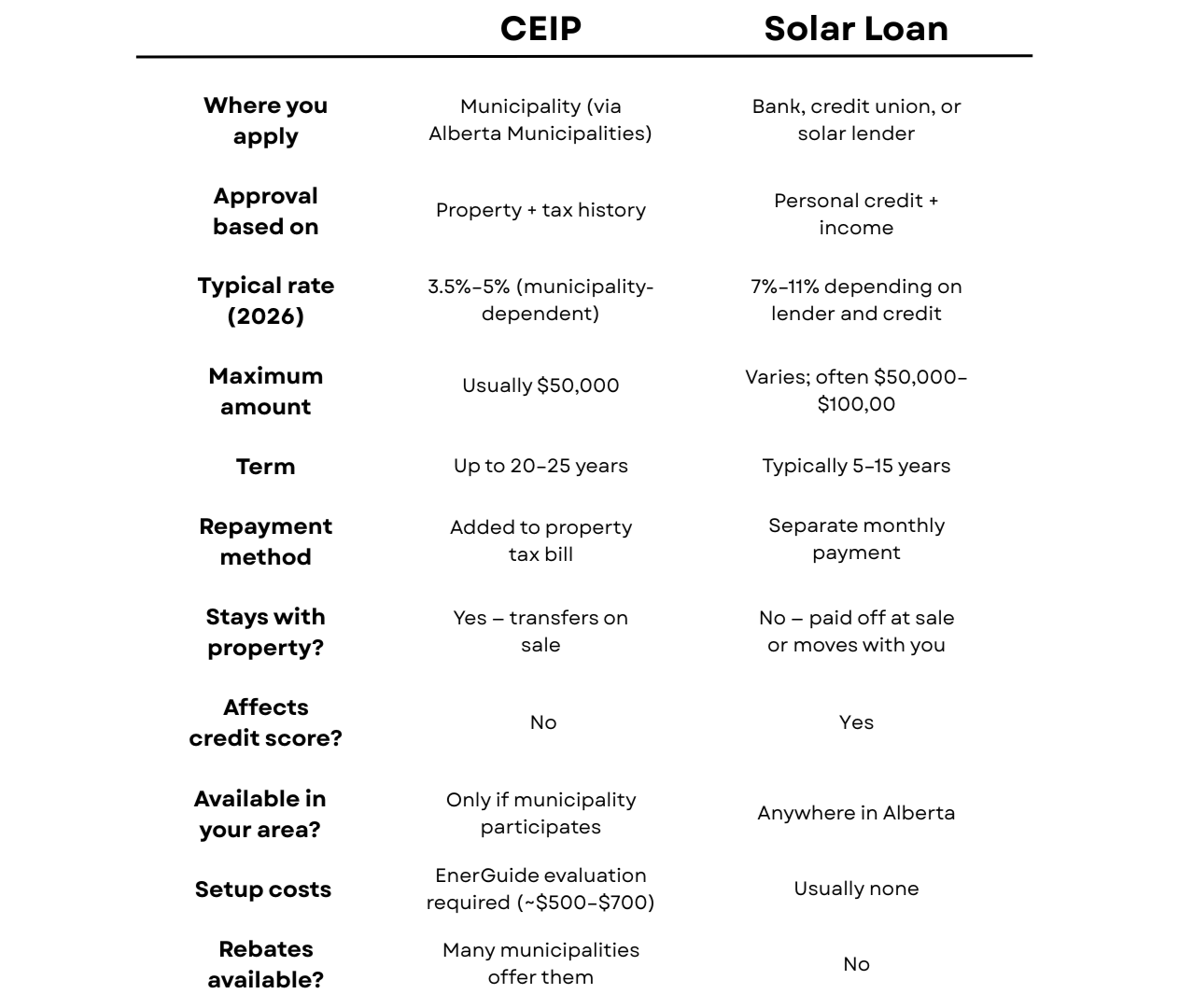
When CEIP is the better option
You qualify and your municipality participates. This is the obvious one. If both conditions are true, CEIP almost always wins on cost.
You want the lowest monthly payment. The 20-year term combined with the lower interest rate means CEIP usually has the lowest possible monthly cost. That's the entire point of structuring it through property tax.
You don't want it on your personal credit. CEIP doesn't show up on your credit report, doesn't affect your debt-to-income ratio for future borrowing, and doesn't require a personal credit application.
You're planning to stay in the home long-term. CEIP's strength is the long amortization. If you're going to be there for 10+ years, you'll capture the full benefit.
Rebates are available in your municipality. Beaumont offers up to $1,100. Other municipalities have different rebate structures. A traditional loan has no equivalent.
When a solar loan is the better option
Your municipality isn't on the CEIP list. If you're outside the program area, a solar loan is your route to financing.
You're planning to sell within a few years. Long financing terms only pay off if you stay long enough to benefit. If you know you're moving in 3–5 years, a shorter-term solar loan that's clearly paid off (or paid off at closing) is sometimes simpler than negotiating a CEIP transfer with a buyer.
You want to pay it off faster. CEIP terms are typically 15–20 years. If you want to clear the financing in 5–7 years and own the system free and clear, a shorter-term loan can match that timeline. (CEIP can be paid off early without penalty, but you may still be locked into the monthly cadence.)
Your property has complications. If you're in a condo, a shared-property arrangement, a property with foreclosure history, or have other property-specific issues, CEIP may not approve. A personal loan has no such restrictions.
You're at the CEIP cap and need more. If your project is larger than $50,000, you may need to combine CEIP with a loan for the portion above the cap. In that case, it's worth comparing whether using a single loan for the whole thing is simpler than the split.
A few honest things to know
CEIP isn't free money. You're still paying interest. The interest rate is just better than most loan products.
CEIP isn't instant. The application and approval process is more involved than a typical loan — there's an EnerGuide evaluation, municipal paperwork, and a defined eight-step process. Plan on 8–14 weeks total.
A solar loan can be fast. Some lenders approve solar loans in days, sometimes hours. If timing matters (you're already deep into renovations and want to add solar in the same window), this can matter.
Rates change. The numbers in this article reflect 2026 averages. Both CEIP rates and commercial loan rates move. We confirm current numbers before quoting.
How we recommend deciding
In most situations across Alberta, here's the order we'd suggest:
Check if your municipality offers CEIP. If yes, it's almost always worth the application time.
If CEIP isn't available or you need to move faster, get loan quotes. Specialty solar lenders sometimes have better rates than your home bank — it's worth shopping at least two or three.
Compare total cost over the life of the system, not just monthly payment. Lower monthly payment ≠ cheaper system.
Factor in whether you're staying or moving. This changes the math significantly.
If you want help running this comparison for your specific situation, we'll lay it out in your proposal — both options, real numbers, no spin.
Last reviewed: August 2026